
Learn more about the Commercial Replacement & Attachment Windows Solutions Idea.
Market transformation (MT) works to remove structural barriers and enact strategic interventions to create lasting change in a market that increased the use of a more efficient product or practice. MT theory is the broad conceptualization of how best to address those barriers in order to accelerate adoption of a targeted energy efficient technology or practice. The changes created by strategic interventions grow market share and pull adoption forward in time.
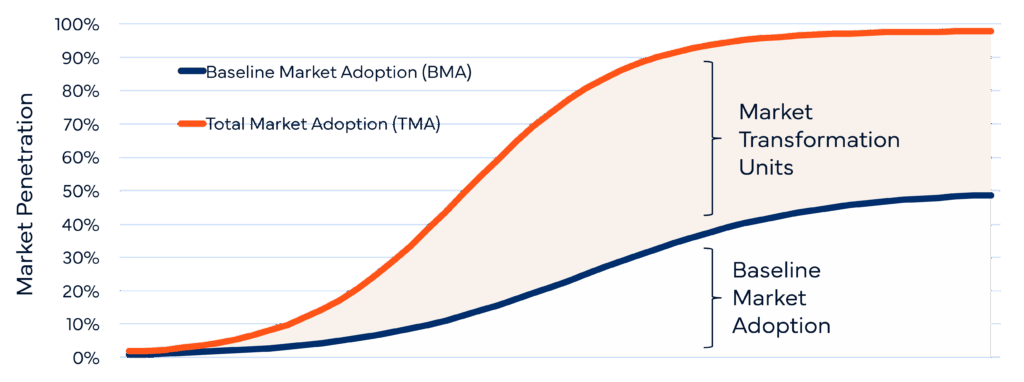
Figure 1 below shows the area between the Baseline Market Adoption and Total Market Adoption S-curves. The differential is the increase resulting from MT activities that deliver cost-effective energy efficiency, greenhouse gas (GHG) reductions, or other identified benefits.
MT theory works to establish clear, measurable inputs and outputs that can be assessed over time. Logic models provide a valuable roadmap to visualize the entire process of market transformation in a comprehensive chart. They depict barriers that make market adoption difficult, opportunities that can be leveraged for development, strategic interventions that will break down barriers, and the resulting outputs over time. In other words, logic models map out the MT theory. CalMTA uses logic models for its initiatives to ensure coherent program organization and clearly defined, measurable outcomes for evaluation. It’s important to know that while the logic model expresses the whole market, some of the interventions or leverage expressed is work that is already happening in a market, such as local efficiency program incentives, or that is anticipated to happen.
Market transformation works by removing barriers through a variety of interventions. The logic model expresses a variety of moving – and dependent – parts into a single model. A carefully conceived initiative logic model provides a tool for expressing and tracking program logic and is vital to successful market transformation.
We’ll use an example from the Commercial Replacement and Attachment Window Solutions (CRAWS) initiative. This initiative aims to accelerate adoption of CRAWS technologies, which are advanced window solutions that improve envelope energy efficiency of existing buildings at a lower cost and with less complex installation than typical full window replacement.
Our team identified several barriers to market adoption of these technologies. They include low awareness among building owners with poor performing windows’ about their impact on energy use, even in mild climates, as well as occupant comfort. Awareness of CRAWS technologies is also generally low.
A logic model not only identifies these barriers as well as market opportunities that could create tailwinds for product adoption, but also the key strategic interventions required to remove the barrier or to leverage the opportunity. A strategic intervention for the CRAWS initiative is to develop in-field demonstrations to document window-related problems and energy and non-energy benefits of CRAWS in target markets. This intervention would assess HVAC/envelope interactions and demonstrate installation simplicity. Wherever possible, the demonstrations would engage energy service companies (ESCOs) to evaluate business model and financing factors.
The in-field demonstrations would also generate case studies to build the case for an “envelope-first” approach for retrofits and document energy and non-energy benefits, best practices, and lessons learned about implementing envelope improvements.
Watch the November 13, 2025 MTAB meeting to learn more about the CRAWS Market Transformation Theory & Logic Model.
A Market Characterization study offers a detailed analysis of the structure, dynamics, and key players within a specific market. It helps identify opportunities and barriers for energy efficiency improvements and supports the design of effective programs and policies. After CalMTA develops Advancement Plans for its Market Transformation Initiatives (MTIs) in consultation with the Market Transformation Advisory Board (MTAB), we begin the process of studying the market for that product or practice through this research. In the case of CRAWS, we initiated the market characterization study in order to build on the initial hypotheses put forward in our CRAWS Advancement Plan and to better understand the unique barriers and opportunities that exist in California.
Decision-making about building renovations is a complex process involving many market actors. Factors such as occupancy status (leased/rented versus owned), tenure of the tenant/owner, and overall economic conditions influence renovation decisions around energy efficiency.
To better understand the decision-making process behind window renovations, CalMTA surveyed business owners and managers to determine who ultimately decides whether to update windows.
One type of CRAWS technology—Commercial Secondary Windows (CSW)—has proven to be a cost-effective alternative compared to traditional full window replacements. However, prevailing perceptions that window upgrades are expensive frequently carry over and shape market actors’ views of this more affordable option. In addition to low market awareness, uptake of CSWs is also slowed by supply chain limitations, inconsistent marketing, and misperceptions about performance and applicability, especially among key decision-makers and midstream actors.
CSW costs will vary based on the product features selected. The number of panes, frame material and types of low-E coatings all impact cost. CSWs are easy to install as they fit over the existing window without requiring any modification of the existing window. They can also be installed without disrupting tenants or occupants.
Watch the November 13, 2025 MTAB meeting to learn more about the CRAWS Market Characterization.
CalMTA seeks to support statewide priorities on environmental and social justice and ensure MTI outcomes reflect the needs and desires of the communities they benefit. To this end, we are working with experts in the California market on equity program development and implementation, including engagement of a dedicated Equity Sounding Board. Learn more about CalMTA’s Equity Lens.
CalMTA applies an equity lens in its market transformation initiative (MTI) development process so that Environmental Social Justice (ESJ) communities receive the benefits of energy efficiency investment. Strategies for making targeted products and practices more accessible to ESJ communities, as well as activities that address unique barriers and opportunities in these communities, are woven throughout the MTI plans and will be proactively considered during implementation.
For the CRTUs MTI, CalMTA refers to ESJ communities as identified through the CalEnviroScreen’s SB535 DAC results dictionary
This MTI recognizes that ESJ communities are disproportionately impacted by both the upfront costs and the complexity and installation quality of HVAC replacements, particularly when replacements occur in emergencies or time-sensitive scenarios.
By focusing on cost-neutral design strategies (e.g., integrating low-cost sensors), and advocating for consistent, affordable product tiers that include connected controls and commissioning (CCC), the initiative seeks to embed equity into both product design and market delivery. Making these products more affordable and widely available will expand access to CRTU technology that reduces operational costs, improves building performance, and supports climate resiliency to ensure that ESJ communities are not excluded from California’s broader electrification efforts.
ESJ impacts are woven throughout all of the CRTUs MTI’s strategic interventions, but the following encapsulate those that will directly work to benefit ESJ communities:
Strategic intervention 1: Engage with manufacturers to prioritize development of variable speed CRTUs with integrated sensors, remote monitoring, and app-based commissioning tools to improve performance and usability for contractors, facility managers, and building owners.
Strategic Intervention 4: Develop and implement contractor training and business outreach strategies to increase installer awareness, confidence, and capability with CCC-enabled and variable speed CRTUs, while leveraging existing workforce development programs and trusted training hubs.

The California Market Transformation Administrator (CalMTA) develops and manages market transformation initiatives in the state to reduce energy use and reduce greenhouse gas (GHG) emissions.


CalMTA follows a rigorous process for reviewing, scoring, and then developing relevant, timely market transformation initiatives. The process supports market transformation initiative creation from concept to program development to market deployment, as well as the eventual exiting of the market.

Learn more about CalMTA’s planning and research on energy efficient technologies and our work to build California’s market transformation portfolio, and access quarterly and annual progress reports.
Want to learn more? Join our mailing list to stay informed about upcoming meetings and events, RFI and RFP announcements, and more.
We welcome your questions and suggestions.
Have questions or comments about CalMTA?
Use our contact form to connect with us, or reach out to:
CalMTA
Resource Innovations
719 Main Street, Suite A
Half Moon Bay, CA, 94019
(888) 217-0217
All Advisory Board meetings are open for public comment. If you’re unable to share your thoughts during an MTAB meeting, access our comment form to to provide your opinion.
Want to learn more? Sign up for our mailing list to receive twice-monthly updates about upcoming events, including Advisory Board meetings, informational webinars, important RFI deadlines, and more.