
Information about the Application

This resource page is designed to help interested parties track and participate in CalMTA’s application to the California Public Utilities Commission (CPUC), which was filed July 7. This “second tranche” of initiatives brings commercial sector technologies into the California Market Transformation Portfolio.

Market transformation is a long-term, high-value strategy that brings energy efficiency and decarbonization benefits to Californians and complements traditional program approaches. CalMTA efforts engage market actors, such as manufacturers, distributors, and retailers, to secure lasting market changes by removing barriers to adoption for targeted products or practices. CalMTA is a program of the CPUC and is administered by Resource Innovations

The Second Tranche of MTIs

Our application (A.26-07-004) seeks approval to implement three statewide energy-efficiency market transformation initiatives (MTIs) in California:

  • Residential Heat Pump Water Heating (HPWH) MTI
  • Commercial Rooftop Units (CRTUS) MTI
  • Commercial Replacement & Attachment Window Solutions (CRAWS) MTI

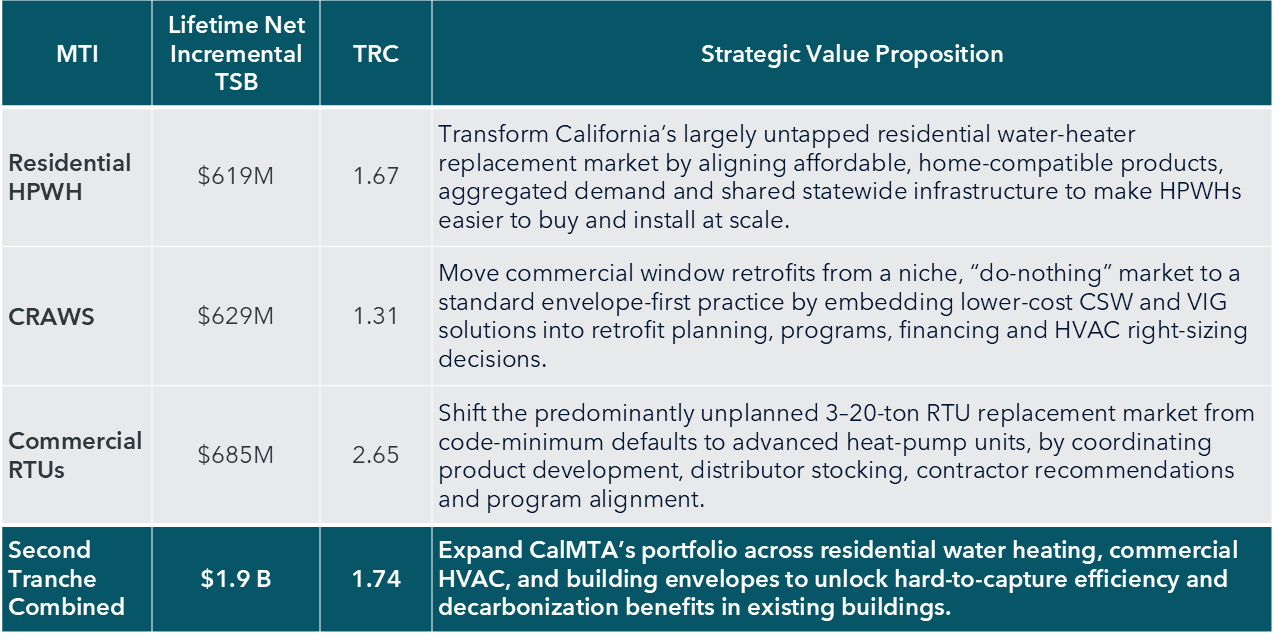
Together, these MTIs are projected to deliver $1.9 billion in Total System Benefits for an investment of just $236 million, which includes:

  • $371 million in energy-savings benefits
  • $258 million in grid benefits
  • $1.3 billion in greenhouse gas (GHG) emissions reduction benefits.

Each MTI is cost-effective, with a Total Resource Cost (TRC) above 1.0, for a positive return on investment of ratepayer dollars. These MTIs also directly support California’s affordability goals by lowering the upfront cost of beneficial efficient technologies and addressing related barriers to adoption while reducing the long-run system costs that are a major contributor to high utility bills. See Table 1 from the Application below for a summary of MTI investment and value.
Learn more about how you can get involved

Overview of the Three MTIs in the Second Tranche

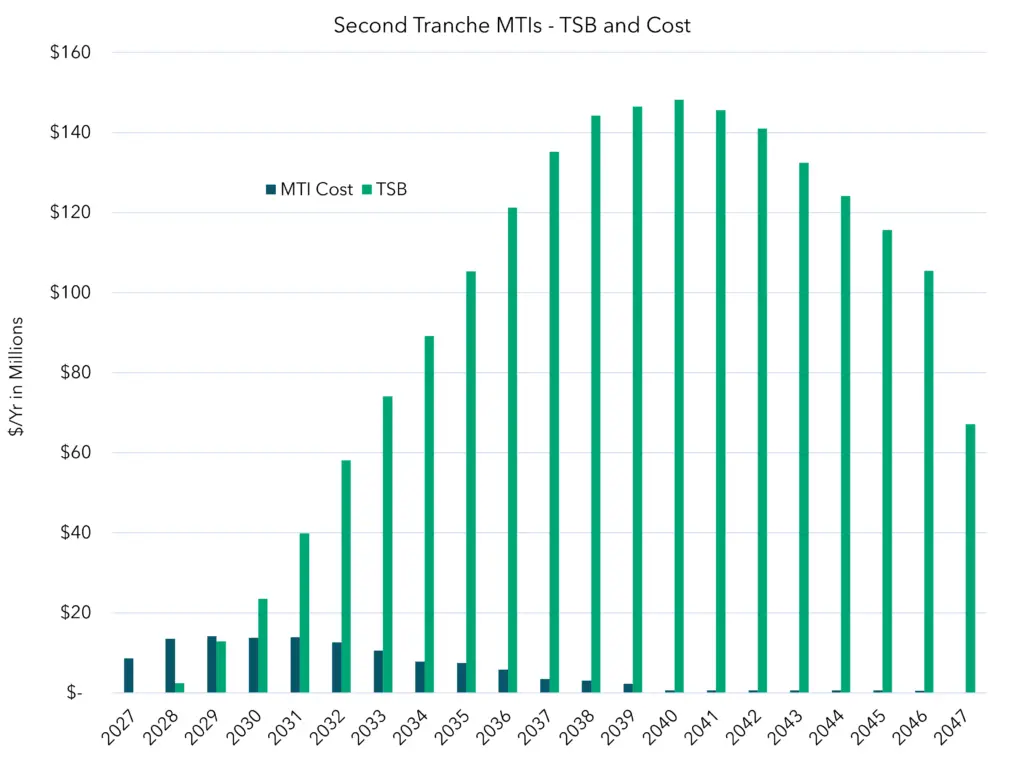
Combined Second Tranche MTI TSB and Cost

All application materials can be found on a dedicated webpage on the CalMTA website. The CPUC’s Proceeding page serves as the official spot for all documents related to the Application.

More information about the key components and benefits of the three MTI Plans can be found below. For questions or support, please contact Alyssa May at [email protected]. 

About the Initiatives in the Second Tranche
Residential HPWH MTI Plan Overview

California’s significant residential water heating replacement market remains dominated by fossil fuels, with only a small market share of heat pump water heaters (HPWHs). Of the approximately 11.5 million households with dedicated water-heating systems, about 76% use natural gas or propane. Roughly 750,000 water heaters are replaced annually, yet HPWHs represent less than 2% of installed systems and only about 5–6% of annual residential water heater sales.

Despite low rates of adoption, HPWHs are a proven energy-efficiency and decarbonization technology that offers energy, GHG, and load-flexibility benefits. The persistent challenge is that the replacement market is still not organized to make HPWHs the routine, easy, and cost-effective default choice for households, installers, retailers, and manufacturers. The Residential HPWH MTI seeks to catalyze market change and deliver significant benefits to California, including:

  • Accelerating market adoption of HPWH has the potential to deliver high Total System Benefits for the state—over $600 million in total:
    • $7.53M in energy savings
    • $538M in GHG reduction
    • $10.08M in grid flexibility
  • Home electrification of water heating is a critical step in realizing the state’s decarbonization goals, including the goal of 6 million heat pumps installed by 2030.
  • As more and more utility rate structures are designed to encourage energy use at specific times, appliance controls are increasingly important. HPWHs are among the easiest electrification measures for consumers to control automatically.
  • Interventions that prepare the market for large-scale adoption will directly support multiple California policies that encourage HPWH adoption: building codes that strongly favor the inclusion HPWH in new residential construction, standards that will be coming into effect for existing water heaters by 2030, and requirements for water heater replacement in the Bay Area that are expected to be effective in January 2028.
  • CalMTA’s MTI seeks to ensure the benefits from HPWH are fully realized and believes that a market-level approach for HPWH will build on the foundation created by programs to achieve the intended growth and lock in the policy vision.
CalMTA’s Commercial Rooftop Units (CRTU) MTI targets the replacement market for single-zone packaged rooftop HVAC units, typically 3–20 tons, in existing commercial buildings. These units serve a large share of California’s commercial building stock: more than half of California commercial floorspace is conditioned by single-zone RTUs, and approximately 64% of that floorspace is heated by gas. The market is heavily shaped by replacement urgency, product availability, first cost, and contractor recommendations, which often leads customers to default to the least expensive, readily available, code-minimum RTU. This MTI seeks to overcome a key market challenge: RTUs are a “workhorse” commercial HVAC technology, but the replacement market is not yet organized to make advanced heat-pump RTUs with connected commissioning and controls, higher cooling efficiency, and variable-speed supply fans the routine default choice. Through strategic market-level interventions, the CRTU MTI will deliver meaningful benefits and transform the statewide market in the following ways:
  • Accelerating market adoption of heat pump RTU with features that increase energy-efficiency and enable better control of performance can deliver significant Total System Benefit for California – an estimated $685M over the MTI’s lifecycle:
    • $170M in energy savings
    • $346M in greenhouse gas (GHG) reduction
    • $169M in grid flexibility
  • Many current RTUs operate inefficiently, consuming more energy and incurring higher operational costs than necessary, and sometimes failing early. They are especially prevalent in small/medium buildings (where over 90% of the floor space is conditioned by single-zone RTUs), a market segment that has historically faced greater barriers to optimizing building energy performance.
  • Businesses will have access to features that deliver energy savings, fewer performance issues, rapid fault detection, and extended lifecycle – contributing to lower operating costs, providing a simpler and significantly lower cost alternative to traditional BMS, and reducing system failure.  This is particularly important for small “mom and pop” businesses that might not otherwise have access to sophisticated tools.
  • The RTU features targeted by this MTI enable better management of electrification impacts, load-shifting, and demand  response (DR) participation that supports the reliability of the electrical grid.
  • By unlocking new pathways to decarbonization and energy performance optimization in the existing-building retrofit market, particularly for small-and-medium businesses, the MTI supports California’s ambitious building decarbonization goals.
CalMTA’s Commercial Replacement & Attachment Window Solutions (CRAWS) MTI targets a major gap in California’s commercial building retrofit market: poor-performing windows are rarely upgraded, even when they contribute materially to heating and cooling loads, comfort issues, and inefficient HVAC sizing. The MTI focuses on two retrofit solutions: Commercial Secondary Windows (CSW), installed over existing windows, and Vacuum Insulated Glass (VIG) for single-pane replacement while retaining the existing frame. This MTI seeks to shift a market in which commercial building owners often default to a “do-nothing” approach for windows because full window replacement is expensive, disruptive, and rarely prioritized in capital planning. As a result, poor-performing windows remain in place until failure or major renovation, while HVAC systems may be replaced or upsized before the envelope is improved. Investment in this MTI creates the opportunity for large-scale statewide benefits and sustainable market changes, including:
  • Accelerating market adoption of Commercial Secondary Windows (CSW) and Vacuum Insulated Glass (VIG) which reduce carbon intensity of buildings through improved building envelope thermal performance and downsized heating, ventilation, and air conditioning (HVAC) systems. This can deliver significant Total System Benefits for the state – an estimated $629M over the MTI’s lifecycle*.
    • $130M in energy savings
    • $420M in greenhouse gas (GHG) reduction
    • $79M in grid flexibility
    • *TSB calculations only include CSW at this time. More market development and research is needed before VIG can be properly modeled.
  • Window attachments represent a significant opportunity to increase energy efficiency and decarbonize the commercial sector. Single-pane and double-pane clear windows are installed in 4.8 billion square feet (73%) of commercial building floor space in California.
  • Shifting from the incumbent “HVAC only” strategy to an envelope-first strategy for building retrofits will enable HVAC downsizing, which will deliver additional eenergy efficiency benefits. For example, if building owners invest in heat pumps before evaluating the impact of envelope retrofits on HVAC sizing, larger heat pumps will be installed placing greater demand on the grid than if the envelope was first improved.
  • California’s developing building performance standards (BPS) strategy creates an urgency for improving window quality for compliance. While colder climates have prioritized window upgrades, California’s high solar heat gains during peak periods highlight the need for better windows to achieve decarbonization targets.
  • The demonstration projects planned as a priority activity in the market deployment phase will validate the business case for window attachments in a real-world setting, deliver learnings to inform MTI strategy refinement, and create opportunities for contractors to gain confidence in the technology firsthand.

The California Market Transformation Administrator (CalMTA) develops and manages market transformation initiatives in the state to reduce energy use and reduce greenhouse gas (GHG) emissions.


CalMTA seeks to help meet California’s energy efficiency and decarbonization goals by accelerating adoption of energy-efficient products and practices through market transformation. Market transformation is a proven strategic process of intervening in a market to create lasting change.
Young Korean female chef working in restaurant kitchen

CalMTA follows a rigorous process for reviewing, scoring, and then developing relevant, timely market transformation initiatives. The process supports market transformation initiative creation from concept to program development to market deployment, as well as the eventual exiting of the market.

The Market Transformation Advisory Board (MTAB) provides expertise and unbiased, non-binding recommendations on CalMTA’s market transformation initiatives. Register here for an upcoming advisory board meeting.

Learn more about CalMTA’s planning and research on energy efficient technologies and our work to build California’s market transformation portfolio, and access quarterly and annual progress reports.

Want to learn more? Join our mailing list to stay informed about upcoming meetings and events, RFI and RFP announcements, and more.  

Subscribe

Name(Required)

Get in touch

We welcome your questions and suggestions.

Have questions or comments about CalMTA?
Use our contact form to connect with us, or reach out to:

CalMTA

Resource Innovations
719 Main Street, Suite A

Half Moon Bay, CA, 94019

(888) 217-0217

Contact Us

Name(Required)

All Advisory Board meetings are open for public comment. If you’re unable to share your thoughts during an MTAB meeting, access our comment form to to provide your opinion.

Subscribe

Want to learn more? Sign up for our mailing list to receive twice-monthly updates about upcoming events, including Advisory Board meetings, informational webinars, important RFI deadlines, and more.

Subscribe

Name(Required)