Opportunities for Participation

Anyone with an interest in the markets, technologies, or goals addressed by CalMTA’s application can choose to engage with the application process via the following pathways:

  1. Share information about the proposed MTIs with your networks or through social media/websites.
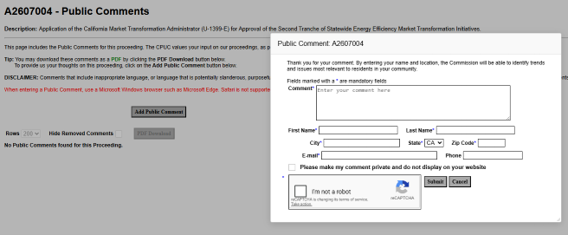
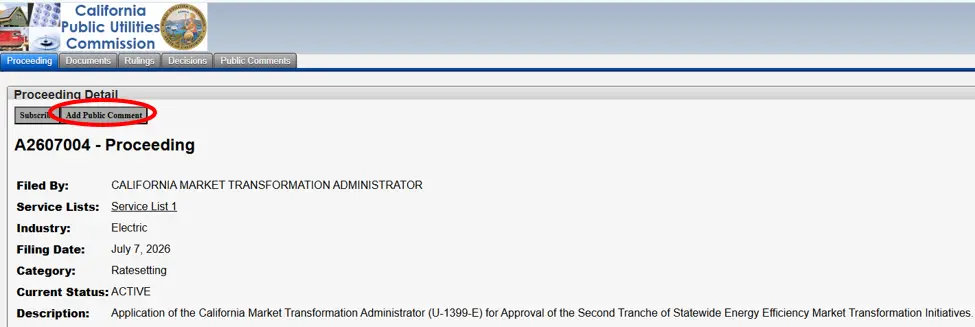
  2. Submit a public comment to the CPUC by visiting the proceeding page and clicking the “Add Public Comment” button (see screenshots below). Comments should be entered into the subsequent pop-up box; submitted comments should substantive and related to the key points of the proceeding (e.g., why a proposed MTI is needed in California).
  3. Submit written ex parte communication expressing your views on the proposed MTIs, either individually or with a group of interested entities). Written ex parte communications are permitted at any time during the proceeding, as long as the submitter sends the communication to all parties (the full service list) on the same day the communication is sent to a decisionmaker (typically the assigned Commissioner). Ex parte letters must be on formal company letterhead and must reference the proceeding number (A.26-07-004). An ex parte letter submitted by advocates during CalMTA’s first CPUC proceeding can be accessed on our website as an example.
  4. Become a party to the proceeding. Becoming a formal party provides the greatest input into shaping or informing the decision made on this application. The most straightforward way to do this is to file a response or protest to the application. Additional options for becoming a party are described on the CPUC webpage.
How will proposed Residential HPWH MTI activities transform the market?

The Residential HPWH MTI seeks to accelerate the transition to efficient electric water heating in California’s residential markets. HPWHs are a proven, high-efficiency technology and are a key solution for achieving the state’s building decarbonization, grid reliability, and climate goals – and a critical component of its target of installing 6 million heat pumps by 2030. 

  • To motivate manufacturers to promote and develop HPWH products that meet California market needs, including new form factors and use of low-GWP refrigerants, the MTI will collaborate with manufacturers, installers, and program partners on a California product roadmap.
  • Developing and deploying Scale-Up Plans focused on sub-markets where a clear value proposition exists for HPWH installation will aggregate demand to bring down product cost.
  • This segmented approach will also build installer experience with and confidence in HPWHs – thus strengthening the business case and improving installation efficiency, resulting in lower costs and better consumer experience.
  • Developing and implementing resources that create consistency and reduce market confusion, including shared product criteria, standardized messaging, and market intelligence hub, will result in greater alignment across programs. This in turn will increase the ease of participation and strengthen the value proposition of HPWHs for market actors while enabling those programs to meet their goals more effectively.


Recognizing the robust landscape of active programs supporting HPWH adoption in California, complementing and coordinating with these partners is integrated into CalMTA’s proposed MTI approach. CalMTA will proactively seek to collaborate with external programs and other interested parties on key activities, including:

  • Development of a shared product roadmap and product criteria, including recommendations for the right 120V HPWH product for California
  • Leverage of existing training efforts to help installers confidently select the right equipment
  • Development and implementation of Scale-Up Plans by submarket, equipped with the data, tools, and resources created through the MIT
  • Streamlining engagement with manufacturers to decrease cost and engage supply chain leaders to champion HPWH adoption
  • Agreement on and support of a coordinated, statewide system for water heater sales and data collection with supply chain and program partners
  • Alignment on consistent, accessible marketing tools and messaging to ensure a consistent customer experience.

The CRTUs MTI seeks to accelerate adoption of advanced heat pump RTUs with innovative features that optimize efficiency and performance but are not currently widely available – unlocking new pathways to cost-effective decarbonization in the commercial sector.

The MTI seeks to impact the CRTU market in the following ways through strategic market-level activities:

  • By collaborating with manufacturers to develop affordable RTUs with desired features, the MTI will make these products more widely available and in turn, lead to more correct installations, optimized system performance, and greater energy savings.
  • Through supply chain engagement, stocking practices across the distribution channel elevate RTUs with beneficial features at the point of purchase – making it easier for contractors and building decision-makers to choose the MTI-preferred product.
  • Technology-specific training and education will increase contractor comfort with advanced features and demonstrate a clear value proposition for contractors to become advocates for these RTUs.
  • Awareness-building marketing to business owners will build demand for RTUs with target features and send a clear signal to manufacturers that motivates accelerated development of affordable RTUs with desired features.
  • Coordinating with external programs and other entities to align on desired product features at the national level will create consistent market signals and coordinated requests that lead to quicker development of desired product types and scaled-up production that brings down product cost.
  • Engaging external programs in California to encourage consistent promotion of and incentives for RTUs with desired features will reduce market confusion and accelerate adoption of advanced RTU technology
  • By working with California codes & standards programs to promote the inclusion of connected controls and commissioning (CCC) in appliance standards will enhance RTU commissioning and improve compliance with acceptance testing requirements.

The CRAWS MTI aims to increase market share of affordable alternatives to full window replacements through retrofit technologies that improve envelope performance, save energy, and deliver comfort to occupants. By enabling an “envelope-first” approach, these technologies help building owners maximize the efficiency of their decarbonization efforts, such as installing a downsized heating, ventilation and air conditioning (HVAC) system. 

The MTI seeks to impact the CRTU market in the following ways through strategic market-level activities:

  • Demonstration projects will quantify the energy savings and non-energy benefits of CRAWS technologies, equipping building decision-makers with the information they need to prioritize window solutions when targeting improved building energy performance.
  • By engaging market actors to build an “envelope first” business case for commercial building upgrades, the MTI will reduce the capital and operational cost of electrification for commercial building retrofits.
  • Market awareness-building with strategic partners and external programs will influence stable industry funding, including consumer-facing incentives, and informing a future ENERGY STAR specification that will motivate more consumer purchases.
  • Implementing demand-side marketing and support, including education and financial tools, will lead to more funding/financing pathways for CRAWS upgrades, including options well-suited to the needs of ESJ communities.
  • Engaging the supply chain to encourage product enhancement and support workforce development will result in increased availability of training and resources for installers – enabling business growth and new career pathways.
  • To make CRAWS products more accessible and widely available, the MTI will increase distribution by engaging industry partners to provide technical support and create demand.

CalMTA applies a market transformation-informed equity lens to ensure that the benefits of energy efficiency delivered through MTIs are accessible to all Californians, including those facing disproportionate energy and environmental burdens. Each MTI in the second tranche therefore has a distinct strategy to bring the benefits of these technologies to environmental and social justice (ESJ) communities sooner, while also looking at overall affordability and accessibility. These strategies, which were developed with input from CalMTA’s Equity Sounding Board, include:

  • Proposed interventions in the Residential Heat Pump Water Heating MTI will improve product affordability through demand aggregation in targeted sub-markets, including those more prevalent in ESJ communities (e.g., rural areas with propane or manufactured housing) or where positive bill impacts are easily achieved (e.g., homes with older electric resistance water heaters). They will also influence manufacturer development of alternative form factors to make HPWH technology more accessible to more homes (such as multifamily units) and will activate the retail channel to support lower-cost installations, paired with trusted community outreach channels and clear, multilingual guidance on costs and bill impacts.
  • The CRTUs MTI seeks to influence development of inclusive training pathways specific to advanced CRTUs with a goal of improving accessibility to ESJ communities and ensuring the availability of a skilled workforce in these communities to install products without a cost premium. Demonstration projects planned for deployment in ESJ communities will validate CRTU savings and other benefits, informing a business case for adoption that reflects the needs and priorities of both contractors and building owners/operators facing equity-specific adoption barriers. The targeted feature of connected commissioning and controls aims to provide small building owners and tenants with accessible, building-management-style functionality, enabling small businesses to take advantage of improved visibility into RTU performance and energy savings that were previously available only in large buildings.
  • The CRAWS MTI specifically addresses barriers faced disproportionately by ESJ communities, including poor-performing envelopes, inefficient HVAC systems, and limited access to financing. Project demonstrations in ESJ communities, conducted in partnership with CBOs, will highlight affordable CRAWS solutions and validate energy, non-energy, and resiliency benefits. By promoting window upgrades as a step before HVAC right-sizing, the MTI’s “envelope-first” business case will support long-term affordability and reduced peak energy demand. The MTI will also engage the supply chain to increase inclusive trainings for installation contractors located in or serving ESJ communities, and will work with ESJ advocates to build community understanding of the technology and promote accessible financing mechanisms.

As a component of the CPUC’s statewide energy efficiency strategy, market transformation seeks to accelerate the adoption of efficient technologies or practices that deliver significant energy savings and GHG emission reductions. By doing so, CalMTA’s work directly contributes to affordability in the following ways: 

  • Improving consumer affordability​. Strategic market transformation interventions remove barriers to adoption to help consumers more easily access and see the value of technologies that use less energy, resulting in lower utility bills than they would experience using inefficient products. Meanwhile, demand aggregation efforts that drive large-scale adoption and associated manufacturer competition reduce the upfront cost of efficient products. Removing market-level barriers to adoption of efficient electric technologies now also helps consumers decarbonize before the cost of gas service goes up significantly, a trend that is already occurring at the national level – in 2025, gas bills increased 60% faster than electric bills and four times faster than inflation. Without market transformation, California risks stranding consumers that face greater barriers to adoption on an expensive gas system.  
  • Reducing long-run system costs. Transmission and distribution costs represent a significant portion of utility customers’ rates – including the high cost of system upgrades required to address a strained electrical grid. Reducing peak demand growth and enabling load flexibility can help postpone these upgrades, resulting in lower costs for all customers. The MTIs in the proposed second tranche directly support these objectives. Shifting the commercial HVAC market toward greater inclusion of connected controls and commissioning through the Commercial Rooftop Unit MTI enables remote adjustment of setpoints to manage peak demand, allows for part-load operation without impacting occupant comfort, and supports pre-cooling or pre-heating before demand response events. The Residential Heat Pump Water Heating MTI looks specifically at strategies that maximize the load-shifting functionalities of certain HPWH products.

Through policy and legislation, California has established some of the most ambitious energy and climate goals in the nation, with energy efficiency as a key solution. In establishing CalMTA, the CPUC has also recognized the vital role of market transformation in accelerating energy efficiency progress cost-effectively while delivering large, lasting, sustainable energy and grid benefits to California. The proposed MTIs are therefore designed to contribute directly to a myriad of statewide goals, including:  

  • Promoting technologies that support load flexibility and demand response, consistent with goals for managing electrification impacts and load-shifting 
  • Unlocking new pathways to building decarbonization and building energy performance optimization, which will support numerous statewide efforts as well as the long-term gas transition  
  • Serving as a key affordability solution through market-level interventions that reduce the upfront cost of technologies and increase the availability of products that make electrification more accessible and cost-effective (e.g., 120V options) 
  • Addressing statewide goals for environmental and social justice through an embedded equity lens that positions MTIs to deliver the benefits of energy efficiency to communities that might otherwise be left behind.  
  • Accelerating adoption of beneficial high-efficiency technologies to reach the energy efficiency savings target set by Senate Bill 350.

The California Market Transformation Administrator (CalMTA) develops and manages market transformation initiatives in the state to reduce energy use and reduce greenhouse gas (GHG) emissions.

CalMTA seeks to help meet California’s energy efficiency and decarbonization goals by accelerating adoption of energy-efficient products and practices through market transformation. Market transformation is a proven strategic process of intervening in a market to create lasting change.
Young Korean female chef working in restaurant kitchen

CalMTA follows a rigorous process for reviewing, scoring, and then developing relevant, timely market transformation initiatives. The process supports market transformation initiative creation from concept to program development to market deployment, as well as the eventual exiting of the market.

The Market Transformation Advisory Board (MTAB) provides expertise and unbiased, non-binding recommendations on CalMTA’s market transformation initiatives. Register here for an upcoming advisory board meeting.

Learn more about CalMTA’s planning and research on energy efficient technologies and our work to build California’s market transformation portfolio, and access quarterly and annual progress reports.

Want to learn more? Join our mailing list to stay informed about upcoming meetings and events, RFI and RFP announcements, and more.  

Subscribe

Name(Required)

Get in touch

We welcome your questions and suggestions.

Have questions or comments about CalMTA?
Use our contact form to connect with us, or reach out to:

CalMTA

Resource Innovations
719 Main Street, Suite A

Half Moon Bay, CA, 94019

(888) 217-0217

Contact Us

Name(Required)

All Advisory Board meetings are open for public comment. If you’re unable to share your thoughts during an MTAB meeting, access our comment form to to provide your opinion.

Subscribe

Want to learn more? Sign up for our mailing list to receive twice-monthly updates about upcoming events, including Advisory Board meetings, informational webinars, important RFI deadlines, and more.

Subscribe

Name(Required)