
Learn more about the Commercial Replacement & Attachment Windows Solutions Initiative and
read the CRAWS MTI Plan.
Commercial Replacement and Attachment Window Solutions (CRAWS) are affordable and convenient window-retrofit technology solutions. They enable building owners to realize energy savings and other benefits while avoiding the high cost and disruption of full window replacement. CRAWS deliver energy savings by reducing HVAC load in both heating and cooling-driven climates, even in California’s mild climate, resulting in reduced peak load reductions, decreased energy consumption, and added potential for peak-shifting.
CRAWS installations have significant non-energy benefits, including:
The CRAWS MTI includes two technologies: vacuum insulated glass (VIG) and commercial secondary windows (CSWs).
The full CRAWS product definition is detailed in Appendix C: Product Assessment.
Watch the January 29 MTAB meeting to learn more about the CRAWS Product Assessment.
Market transformation (MT) works to remove structural barriers and enact strategic interventions to create lasting change in a market that increased the use of a more efficient product or practice. MT theory is the broad conceptualization of how best to address those barriers in order to accelerate adoption of a targeted energy efficient technology or practice. The changes created by strategic interventions grow market share and pull adoption forward in time.
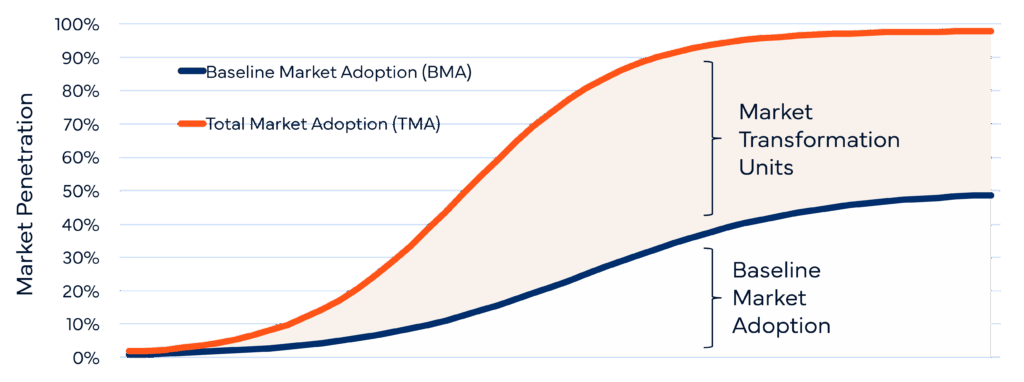
Figure 1 below shows the area between the Baseline Market Adoption and Total Market Adoption S-curves. The differential is the increase resulting from MT activities that deliver cost-effective energy efficiency, greenhouse gas (GHG) reductions, or other identified benefits.
MT theory works to establish clear, measurable inputs and outputs that can be assessed over time. Logic models provide a valuable roadmap to visualize the entire process of market transformation in a comprehensive chart. They depict barriers that make market adoption difficult, opportunities that can be leveraged for development, strategic interventions that will break down barriers, and the resulting outputs over time. In other words, logic models map out the MT theory. CalMTA uses logic models for its initiatives to ensure coherent program organization and clearly defined, measurable outcomes for evaluation. It’s important to know that while the logic model expresses the whole market, some of the interventions or leverage expressed is work that is already happening in a market, such as local efficiency program incentives, or that is anticipated to happen.
Market transformation works by removing barriers through a variety of interventions. The logic model expresses a variety of moving – and dependent – parts into a single model. A carefully conceived initiative logic model provides a tool for expressing and tracking program logic and is vital to successful market transformation.
We’ll use an example from the Commercial Replacement and Attachment Window Solutions (CRAWS) initiative. This initiative aims to accelerate adoption of CRAWS technologies, which are advanced window solutions that improve envelope energy efficiency of existing buildings at a lower cost and with less complex installation than typical full window replacement.
Our team identified several barriers to market adoption of these technologies. They include low awareness among building owners with poor performing windows’ about their impact on energy use, even in mild climates, as well as occupant comfort. Awareness of CRAWS technologies is also generally low.
A logic model not only identifies these barriers as well as market opportunities that could create tailwinds for product adoption, but also the key strategic interventions required to remove the barrier or to leverage the opportunity. A strategic intervention for the CRAWS initiative is to develop in-field demonstrations to document window-related problems and energy and non-energy benefits of CRAWS in target markets. This intervention would assess HVAC/envelope interactions and demonstrate installation simplicity. Wherever possible, the demonstrations would engage energy service companies (ESCOs) to evaluate business model and financing factors.
The in-field demonstrations would also generate case studies to build the case for an “envelope-first” approach for retrofits and document energy and non-energy benefits, best practices, and lessons learned about implementing envelope improvements.
Watch the November 13, 2025 MTAB meeting to learn more about the CRAWS Market Transformation Theory & Logic Model.

A Market Characterization study offers a detailed analysis of the structure, dynamics, and key players within a specific market. It helps identify opportunities and barriers for energy efficiency improvements and supports the design of effective programs and policies. After CalMTA develops Advancement Plans for its Market Transformation Initiatives (MTIs) in consultation with the Market Transformation Advisory Board (MTAB), we begin the process of studying the market for that product or practice through this research. In the case of CRAWS, we initiated the market characterization study in order to build on the initial hypotheses put forward in our CRAWS Advancement Plan and to better understand the unique barriers and opportunities that exist in California.
Decision-making about building renovations is a complex process involving many market actors. Factors such as occupancy status (leased/rented versus owned), tenure of the tenant/owner, and overall economic conditions influence renovation decisions around energy efficiency.
To better understand the decision-making process behind window renovations, CalMTA surveyed business owners and managers to determine who ultimately decides whether to update windows.
One type of CRAWS technology—Commercial Secondary Windows (CSW)—has proven to be a cost-effective alternative compared to traditional full window replacements. However, prevailing perceptions that window upgrades are expensive frequently carry over and shape market actors’ views of this more affordable option. In addition to low market awareness, uptake of CSWs is also slowed by supply chain limitations, inconsistent marketing, and misperceptions about performance and applicability, especially among key decision-makers and midstream actors.
CSW costs will vary based on the product features selected. The number of panes, frame material and types of low-E coatings all impact cost. CSWs are easy to install as they fit over the existing window without requiring any modification of the existing window. They can also be installed without disrupting tenants or occupants.
Watch the November 13, 2025 MTAB meeting to learn more about the CRAWS Market Characterization.
The Logic Model is a systematic and visual way of presenting CalMTA’s understanding of the interventions necessary to remove barriers, expected outcomes of those interventions, and a pathway to the desired end state.
This market characterization report is an output of the Phase II research for the Commercial Replacement and Attachment Window Solutions (CRAWS) Advancement Plan, finalized in September 2024. CRAWS in this report specifically refers to vacuum insulated glass (VIG) and commercial secondary windows (CSW).
The Market Characterization Report was discussed during the Jan. 29 Market Transformation Advisory Board Meeting.
Market transformation is a strategic process of intervening in a market to create lasting change. CalMTA developed a Market Transformation Initiative Evaluation Framework to lay out how we will track and evaluate the impact and cost-effectiveness of our MTIs. For each of our initiatives we develop a theory of market transformation and logic model that identifies expected short-, medium-, and long-term market outcomes resulting from strategic market interventions. Third-party evaluators will evaluate market progress based on the Market Progress Indicators (MPIs) and Milestones developed for each MTI.
An Outcome is the market’s response to one or more MTI’s strategic market interventions. While the end goal may be to accelerate market adoption of CRAWS, this is a long-term initiative that must be assessed over time. While some outcomes will be realistic in a few years, others may take a decade to fully realize. For the CRAWS MTI, there are 20 Outcomes in the logic model that we expect to result from our work.
MPIs are metrics developed to assess logic model outcomes and track an MTI’s progress toward the desired market changes. MPIs may be qualitative or quantitative.
Milestones are the specific expected quantitative or empirical markers of an MPI’s value, status, or condition at a specific point in time. While MPIs are the metric used to track market progress, Milestones track the value, status, or condition the program wants to see at specific points in time to ensure the program achieves the MTI’s ultimate goals within the expected timeframe. Together, these metrics allow CalMTA to assess the MTI’s performance and identify elements that are on-target and elements that are performing differently than expected, so that CalMTA can make timely course corrections, as appropriate.
CalMTA has identified several different strategic interventions necessary for transforming the market for CRAWS. One of those is to develop an “envelope-first” business case for commercial buildings. The table below shows the Outcomes we seek to achieve in the short-, medium-, and long-term time frames along with the MPIs and Milestones we’ll use to track our impact. The Milestones will show evidence of change in the market.
Note: This is one draft example from several planned interventions. The final MPIs and Milestones may be updated in the final MTI Plan.
LM outcome | Time frame | MPI | Milestone or trend |
CA external programs include CRAWS technology in list of measures | Short-term | Number of external programs that include CRAWS measures | Three CA Investor- Owned Utility (IOU) Energy Efficiency (EE) programs include CRAWS measures by 2029 |
CA external programs increasingly offer incentives for CRAWS products Incentives offered for evaluating envelope as part of HVAC updates | Med-term | Number of CA external programs that include CRAWS measures Number of CA external programs that offer incentives for evaluating envelope as part of HVAC updates | Three CA IOU EE programs launch incentives for envelope assessments conducted alongside HVAC replacements by 2032 |
By 2045, 50% of HVAC replacements or upgrades include envelope evaluation | Long-term | % of HVAC upgrades that include envelope assessment | 25% of surveyed HVAC projects included envelope assessment as part of sizing analysis by 2040 |
View all Logic Model Outcomes, MPIs and Milestones in Appendix F: Evaluation Plan.
Watch the January 29 MTAB meeting to learn more about the CRAWS MPIs and Milestones.
The Total System Benefit (TSB) is the dollar-value metric that measures energy savings, grid benefits and reliability, and greenhouse gas (GHG) impacts. In 2021 the California Public Utilities Commission (CPUC) announced its intention to use this approach to evaluate the State’s energy efficiency programs to better align them with GHG emissions reduction, support for customer equity, and long-term grid stability. In the past, the CPUC’s dollar-value metrics had been based on kilowatt-hours, kilowatts, and therms, but this new TSB approach encourages programs to target high-value load reductions without directly comparing one fuel source against another (i.e., gas vs. electricity). It focuses on the benefits to the “total system” – including residents’ health and environmental concerns – rather than one particular fuel source. The CPUC officially adopted this new approach in 2024.
As California’s first Market Transformation Administrator, CalMTA is working to create energy efficiency initiatives that will create lasting change in a market. A crucial part of that work is understanding just how much a particular initiative will benefit California. While our MTIs seek to generate energy savings and related benefits by accelerating and increasing market adoption of energy-efficient technologies and practices, we need to evaluate those MTIs carefully.
TSB helps us measure our MTIs’ impact. Carefully estimating the energy impacts and cost-effectiveness of an MTI is crucial to understanding it and its value to Californians. Good estimates require developing a forecasting model that uses a set of inputs based on well-documented sources, methods, and assumptions. Getting the TSB right is as much about good research as it is about good math.
The CRAWS MTI will deliver an estimated $509 million in TSB from 2028-2046, including $105.4 million in energy benefits, $63.8 million in grid benefits, and $339.6 million in GHG benefits.
Not only do our initiatives need to demonstrate a beneficial TSB; they need to be cost-effective. Cost-effectiveness is measured by comparing the initiative’s benefits with the costs. Various tests are used to provide different information about the impacts of the initiative from distinct vantage points. Together, these tests provide a comprehensive picture of the initiative’s cost-effectiveness:
The TRC and SCT cost tests help to answer whether efficiency is cost-effective overall. The PAC helps to answer whether the selection of measures and design of the program is balanced from the utility perspective. Collectively, these tests reveal the cost-effectiveness from the perspective of various stakeholders including program participants, utilities, or California as a whole.
The CRAWS initiative will be cost-effective under all test perspectives.
CRAWS MTI cost-effectiveness estimates:
TRC | PAC | Base SCT | High SCT |
1.31 | 19.2 | 1.82 | 1.84 |
CalMTA has forecasted the baseline market adoption (BMA) and total market adoption (TMA) of CRAWS. BMA represents the expected “naturally occurring” market adoption based on current and expected market, policy and technological trends. TMA includes the additional adoption driven by the MTI’s strategic interventions including awareness-building, in-field demonstrations, technical-resource development, supply-chain engagement, installer training, and efforts to establish the envelope-first business case for commercial buildings.
While adoption increases under both scenarios, TMA rises more quickly. The difference between the BMA and TMA represents the statewide incremental adoption attributable to the MTI.
Watch the May 6 MTAB meeting to learn more about the CRAWS TSB and cost-effectiveness.

CalMTA seeks to support statewide priorities on environmental and social justice and ensure MTI outcomes reflect the needs and desires of the communities they benefit. To this end, we are working with experts in the California market on equity program development and implementation, including engagement of a dedicated Equity Sounding Board. Learn more about CalMTA’s Equity Lens.
Market Transformation Initiative (MTI) Plan development at CalMTA benefits from the cross-cutting tools and resources developed to support application of CalMTA’s equity lens, including feedback from our Equity Sounding Board and an equity consultant embedded across MTI teams. CalMTA also follows documented guidance for integrating equity considerations into market research, logic models, and strategic interventions. This work is manifested in market-informed equity approaches for each of CalMTA’s initiatives, as described below.
These less disruptive, more affordable window products make the benefits of envelope upgrades – lower operating costs, enhanced comfort, and increased resilience – more accessible to building owners/operators with limited resources. The technology’s non-energy benefits, such as thermal comfort and noise-abatement, are particularly valuable to older, less efficient buildings serving ESJ communities, such as public schools in low-income, high-pollution areas.
MTI interventions address barriers faced disproportionately by ESJ communities, including poor-performing envelopes, inefficient HVAC systems, and limited access to capital and/or financing.

The California Market Transformation Administrator (CalMTA) develops and manages market transformation initiatives in the state to reduce energy use and reduce greenhouse gas (GHG) emissions.


CalMTA follows a rigorous process for reviewing, scoring, and then developing relevant, timely market transformation initiatives. The process supports market transformation initiative creation from concept to program development to market deployment, as well as the eventual exiting of the market.

The Market Transformation Advisory Board (MTAB) provides expertise and unbiased, non-binding recommendations on CalMTA’s market transformation initiatives. Register here for an upcoming advisory board meeting.
Learn more about CalMTA’s planning and research on energy efficient technologies and our work to build California’s market transformation portfolio, and access quarterly and annual progress reports.
Want to learn more? Join our mailing list to stay informed about upcoming meetings and events, RFI and RFP announcements, and more.
We welcome your questions and suggestions.
Have questions or comments about CalMTA?
Use our contact form to connect with us, or reach out to:
CalMTA
Resource Innovations
719 Main Street, Suite A
Half Moon Bay, CA, 94019
(888) 217-0217
All Advisory Board meetings are open for public comment. If you’re unable to share your thoughts during an MTAB meeting, access our comment form to to provide your opinion.
Want to learn more? Sign up for our mailing list to receive twice-monthly updates about upcoming events, including Advisory Board meetings, informational webinars, important RFI deadlines, and more.