With 70% of California households cooking with gas appliances, it’s hard to imagine how the State will meet its decarbonization goals without shifting the market toward a viable electric alternative. Induction cooking products have the potential to play this role: they deliver significant health, safety, and energy-efficiency benefits while providing the high-quality cooking experience consumers want. CalMTA’s work to develop an initiative focused on accelerating market adoption of induction technology has demonstrated the value this could bring to California – and identified a critical need to break down barriers that are keeping induction products from becoming widely accessible to consumers.
In addition to common barriers like higher upfront cost, one key barrier requires innovative new approaches. Existing homes and apartments with gas-fueled stoves are often not able to switch to energy-efficient electric appliances without also upgrading their electrical panel or infrastructure, which can add thousands of dollars to the cost. An emerging battery-enabled 120-volt (V) induction range could be a game changer in overcoming this obstacle. But can these products deliver the same cooking experience as standard 240V induction options, especially when multiple hobs and the stove are in use at the same time?
CalMTA sought to answer this question by testing the performance of 120V battery-equipped induction products through a field study conducted in partnership with the Association for Energy Affordability (AEA), the nonprofit Eden Housing, and Copper, maker of the Charlie range. Installing these ranges in units at Emerson Arms, an affordable multifamily building in Martinez, CA, allowed CalMTA to gain valuable insight into the way residents use battery-equipped induction technology in their day-to-day lives and how our assessment of the technology’s performance in these scenarios can support continued market development.
Key findings from the field study are summarized below, with additional detail provided in the final report published by CalMTA.
Study logistics
Copper’s “Charlie” 120V induction range was installed in 32 apartments at Emerson Arms. The range includes an integrated 5 kWh battery, which works to enable full-performance induction cooking on a standard 120V/15 amp household circuit. Between Nov. 2024 and May 2025, CalMTA collected both detailed usage data (from cooking “events” collected every three minutes) and resident feedback to understand performance, user experience, and opportunities for future product refinement. 23 of the participating households shared cooking data and 20 households completed in-person surveys.
Key findings
1. Battery capacity was sufficient for almost all cooking needs.
The integrated battery proved highly capable, fully supporting nearly all (99.98%) of the 6,175 documented cooking events. Across cooking events, the battery dropped below 1% charge only once and was below 10% charge less than 10% of the time.
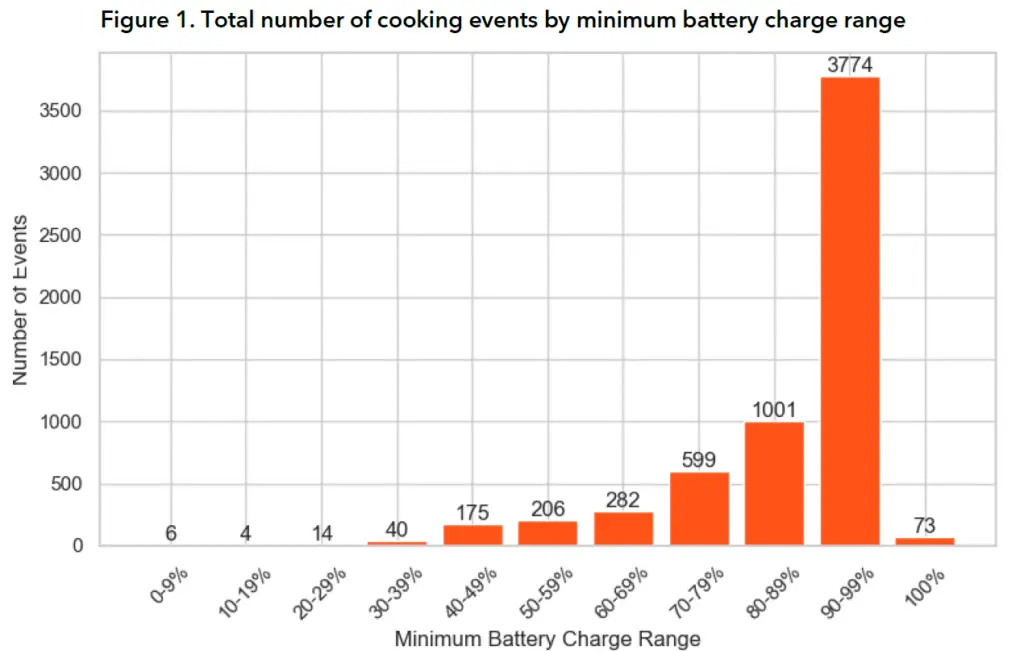
Residents did receive “low power” alerts at 30% and 20% state of charge, and survey feedback suggests these alerts sometimes influenced behavior—an important consideration for product design and messaging. Nonetheless, study results indicate that a 5 kWh battery is adequate for daily cooking needs in most multifamily homes, even when the range is installed on a shared circuit with limited charging opportunity.
2. Oven and cooktop when used together require a higher power output.
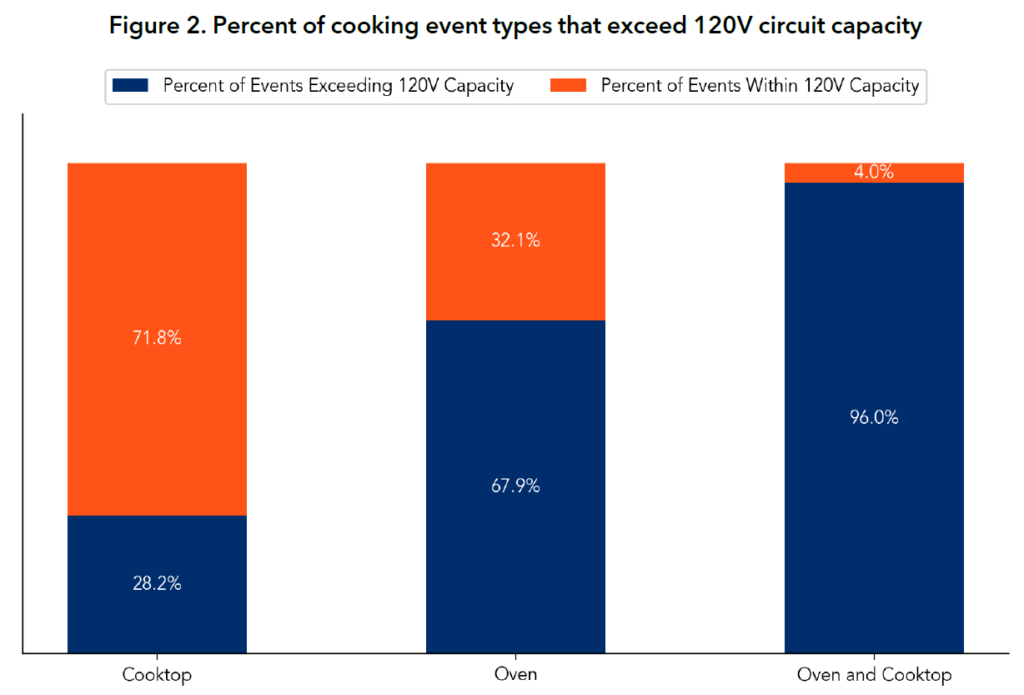
In 816 of the cooking events (13.2%), residents combined the use of the oven with at least one cooktop hob, which required the range’s power output to operate both end-uses simultaneously. This points to the real-world need for high peak power output – something a 120V battery-equipped product can provide even when the home’s electrical circuit cannot. The accompanying graph shows the percentage of cooking events that were within and exceeded the 120V capacity.
3. A slightly smaller battery may be possible, but with tradeoffs.
Energy-use patterns of the participating households showed that in almost all instances (99.91%) cooking needs could still be met with a battery capacity that is 10% smaller than the current 5 kWh model. Only 3% of all events consumed more than 5 kWh total, but those high-use events occurred on holidays or special occasions – times when high performance is particularly important. To ensure high consumer satisfaction, any battery-size reductions by manufacturers should be approached cautiously and conduct additional research with larger samples.
4. Cooking habits vary—but more cooktop hobs in use don’t necessarily mean higher power.
Most cooktop-only events are relatively simple, with 77% using only one cooktop heating zone. However, when the oven is involved, the distribution shifts with 43% of events using two or more concurrent cooktop heating zones, implying that when the oven and cooktop heating zones are used together, the cooking setup tends to be more elaborate. Multi-hob plus oven events tended to use lower mean power but for longer durations, suggesting these meals included more low-heat simmer or multi-step cooking.
6. Overall satisfaction with the Copper product was high.
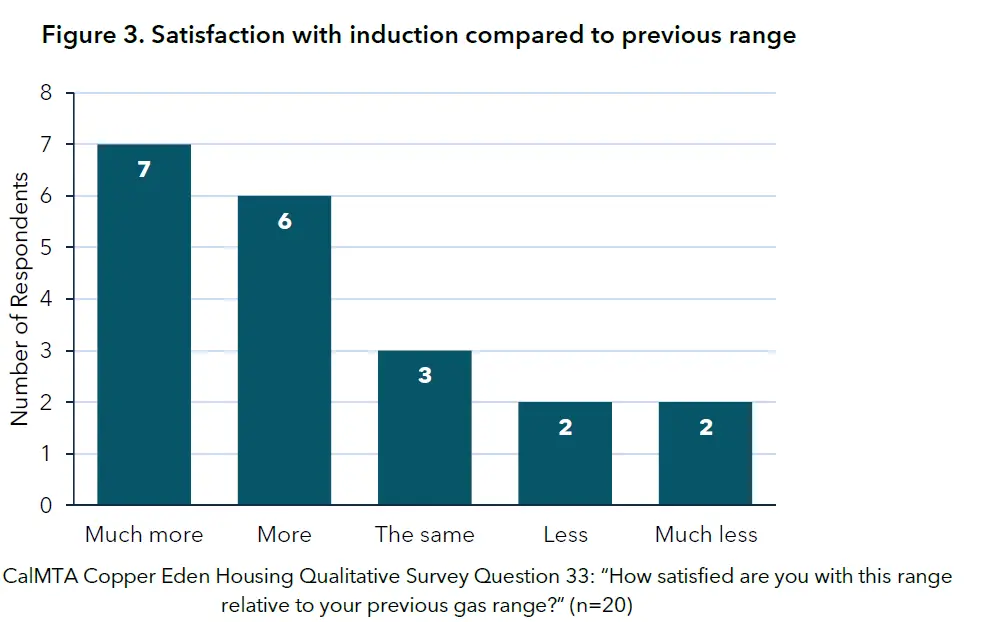
Of the 20 residents surveyed, 13 reported a higher level of satisfaction with the installed induction range than with their previous gas stove. Ease of cleaning, fast and precise cooking performance, and lower burn risk were identified as benefits appreciated by residents. Seventeen of the 20 residents said the induction range felt safer – the highest-ranked benefit overall and important insight for consumer messaging.
7. The learning curve of transitioning to induction can be eased by support and education.
Challenges reported by participants were mostly related to learning the new technology – adjusting to the unique heat behavior of induction, understanding what factors triggered the range to shut off, and learning what cookware was compatible. In most cases, these issues were quickly resolved through help from property management, Copper’s customer support, or simply the residents’ own experience using the new range. Seeing the technology in use also contributed to resident understanding. In a chef-led cooking demonstration conducted before the Copper ranges were installed, which 15 of the residents attended, 73% of those said the demonstration was “very helpful.”
What’s next
While CalMTA’s field study represents a small sample size, it yields important real-world insight that validates 120V battery-equipped induction ranges as a viable, resident-approved solution for multifamily buildings – especially in situations where 240V service upgrades are costly or impractical. CalMTA will expand this data set with research conducted at other multifamily sites in California, using the results to make recommendations to manufacturers for future induction product development. Research findings will also inform CalMTA’s Induction Cooking Market Transformation Initiative (MTI) Plan, which features market-level interventions designed to increase the availability of 120V induction options in California and was conditionally approved by the California Public Utilities Commission (CPUC) on Nov. 20.
For more information about the Emerson Arms field study, including recommendations for how manufacturers, contractors, and external programs can apply key findings, access the final report here.