
California has established a strong policy foundation for energy efficiency and building decarbonization. CalMTA’s Second Tranche of Market Transformation Initiatives (MTIs), submitted to the California Public Utilities Commission (CPUC) in July for funding approval, will help build the market capacity needed to translate California’s policy direction into practical, affordable, and durable improvements in existing buildings.
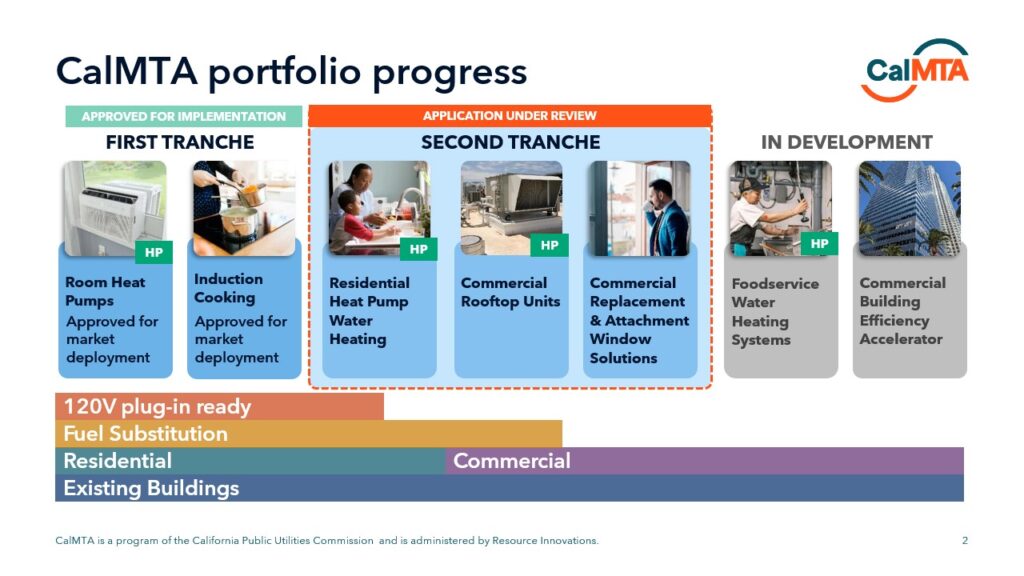
The Second Tranche includes Residential Heat Pump Water Heating (HPWH), Commercial Rooftop Units (CRTUs), and Commercial Replacement and Attachment Window Solutions (CRAWS). Together, these initiatives are projected to bring $1.9 billion in total system benefit (TSB) over their lifetimes to Californians. These efforts would extend market transformation (MT) across residential and commercial buildings, equipment and envelope measures, and multiple pathways for reducing energy use, greenhouse gas emissions, fossil fuel dependence, and peak demand (these last three represent the components of TSB). Each MTI addresses the systemic conditions that shape adoption by:
- Aligning product development and market-building strategies with California’s needs and affordability goals
- Strengthening statewide delivery through coordination and market engagement
- Building awareness, technical capacity, and workforce readiness
- Prioritizing applications that lower the cost of adoption and operation and improve building energy performance
Supporting Policy Intentions with MT
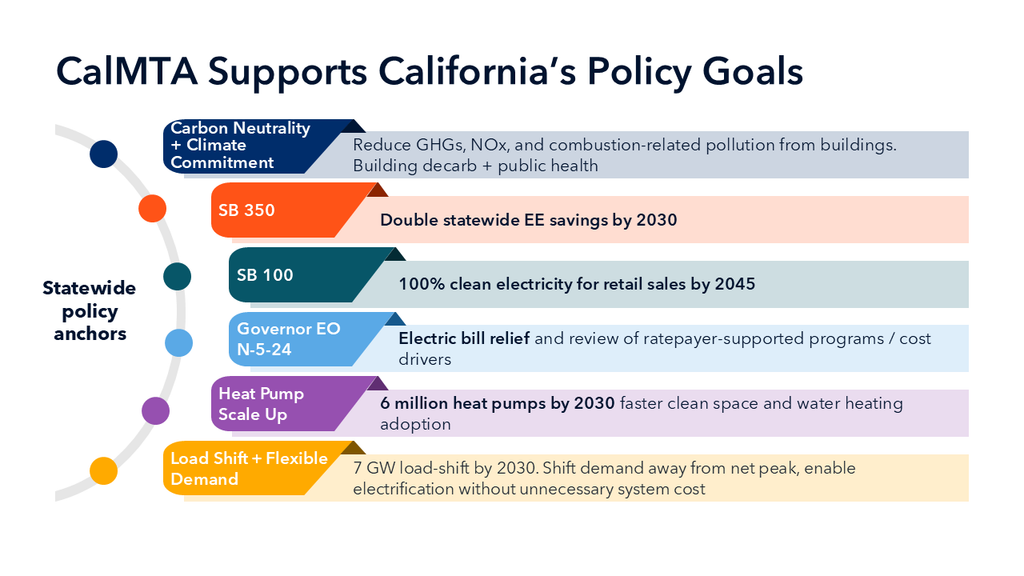
California has established goals and assembled enabling policies for its clean energy transition. The recently adopted 2025 Integrated Energy Policy Report (IEPR) provides a statewide planning anchor, combining an updated energy-demand forecast with analysis of the reliability, affordability, electrification, and grid priorities shaping that transition. Notably, the IEPR’s Additional Achievable Fuel Substitution scenarios recognize MT as a driver of additional zero-emission appliance adoption beyond the impacts attributed to traditional efficiency programs and incremental codes and standards.
The Clean Energy and Pollution Reduction Act of 2015 (SB 350) set the course for doubling statewide energy efficiency savings by 2030 and directed the CPUC to authorize long-term, market-level programs capable of achieving deep and lasting savings. That mandate operates alongside SB 32, which established California’s 2030 greenhouse gas reduction target, and SB 100, which set the state on a path to 100% clean electricity by 2045. The CPUC advanced SB 350’s market transformation mandate by establishing an MT framework and providing for a single, independent, statewide Market Transformation Administrator, which operates now as CalMTA.
Within this policy and program landscape, CalMTA complements investments in incentives, technical assistance, workforce development, and demonstrations delivered by Clean TECH California, BUILD, utilities, Regional Energy Networks, community choice aggregators, equity-focused programs, and others. By addressing statewide barriers that no single program can overcome alone, the Second Tranche can help make efficient technologies more available, affordable, and accessible over time.
For CalMTA, equity and affordability are conditions for durable market transformation. The CEC’s Equitable Building Decarbonization Program, the CPUC Environmental and Social Justice Action Plan, and Governor Newsom’s Energy Affordability Executive Order (N-5-24) reinforce the need to expand access without increasing energy burdens. Each of the three initiatives have strategies specifically designed to bring benefits of the efficiency investment to the State’s Environmental and Social Justice communities.
The CPUC’s broader building-decarbonization actions reinforce this direction. Through the Building Decarbonization Rulemaking, the Commission implemented the SB 1477 BUILD and TECH initiatives and is implementing SB 1221 voluntary neighborhood decarbonization pilots as part of orderly gas transition Building Decarbonization. Together, these actions support market readiness for efficient electric alternatives. Initiatives in the MT portfolio being developed by CalMTA are poised to support realization of this policy intention.
Focus on Existing Buildings
New construction is increasingly addressed through codes and standards, including the 2025 Building Energy Efficiency Standards (Title 24, Part 6), which expand heat pump use and electric-readiness requirements for newly constructed residential buildings. The harder remaining challenge is the existing-building market, where adoption depends less on whether the policy direction is clear and more on whether products are available, contractors are prepared, delivery channels are functioning, and customers can adopt efficient technologies at manageable cost and complexity. These replacement and retrofit opportunities are central to the 2025 California Building Energy Action Plan and the California Building Energy Performance Strategy developed under SB 48, which connect efficiency and electrification with building performance, benchmarking, comfort, and load flexibility.
The Residential Heat Pump Water Heating (HPWH) MTI responds directly to challenges in the replacement market by making high-efficiency electric water heating a realistic replacement option when an existing system fails. This MTI complements existing programs with strategies to improve product availability, installer readiness, installation pathways, and customer confidence.
The Commercial Rooftop Units (CRTUs) and Commercial Replacement and Attachment Window Solutions (CRAWS) MTIs apply the same logic to a replacement-driven commercial building market. Commercial above-code heat pump rooftop units paired with connected controls can reduce onsite combustion and energy use while enabling more responsive operation. The CRAWS MTI adds an envelope-first strategy through commercial window retrofits, including secondary windows and vacuum-insulated glass, which can reduce thermal loads, improve comfort, and support the installation of smaller, more efficient HVAC systems.
Together, the three MTIs advance California’s existing-building policy agenda. The HPWH MTI aligns with the 2022 California Air Resources Board (CARB) Scoping Plan, CARB’s developing Clean Space and Water Heater Standards, the Bay Area Air Quality Management District’s zero-NOx Rule 9-6 for covered water heaters, and Governor Newsom’s goal of installing 6 million heat pumps in California buildings by 2030. The CRTU and CRAWS MTIs translate SB 48’s existing-building objectives into equipment and envelope market strategies. Although these policies differ in scope, timing, and regulatory status, all underscore the need to prepare markets before customers face replacement decisions.
Finally, the 100 Percent Clean Energy Act of 2018 (SB 100) requires California to provide 100% clean energy by 2045. Achieving that target entails managing electricity demand. Pursuant to SB 846, the CEC adopted a 7,000 MW statewide load-shift goal for 2030 to reduce net peak demand and support reliability without increasing greenhouse gas emissions or electric rates. Heat pump water heaters and connected CRTUs can contribute to that goal, while CRAWS reduces the building load that must be served in the first place.
Long-Term Strategy for High-Value Outcomes
Affordability is essential to widespread market change. The MTIs can lower adoption costs by strengthening supply chains, simplifying installation, and leveraging non-ratepayer investment.
For its $121 million investment, the three MTIs would deliver roughly $16 in benefits to ratepayers for every dollar spent. They could also reduce customer equipment costs and defer grid-infrastructure investments.
At a time of growing pressure on public funding and customer affordability, California needs strategies that deliver more than near-term installations. By coordinating market actors, lowering adoption barriers, and creating durable changes in product availability and delivery, this Second Tranche of initiatives can extend the value of public and ratepayer investments well beyond individual programs or incentives — turning California’s policy ambitions into a market better equipped to deliver affordable, scalable, and lasting progress.
By Smita Gupta, Principal, Policy at CalMTA